
Midwest hail damage · Documented inspections since 1947
Hail Damage vs Normal Roof Wear: Telling Them Apart
The single most argued finding on a hail claim. Pattern, feel, and the metals around the roof are what separate a storm from twenty summers of sun.
Short answer
Hail damage is random and has no pattern. Normal wear is uniform and follows the sun. Hail leaves scattered bruises with fractured mat underneath and matching fresh dents on nearby metals. An aging roof sheds granules evenly across its most sun-exposed slopes, curls at the tab edges, and shows no corresponding metal damage anywhere on the property. The metals are what separate the two findings.
Pattern is the first thing an estimator reads
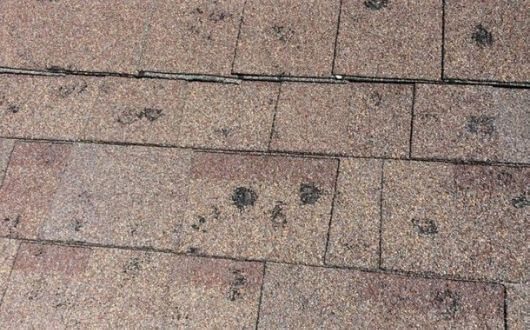
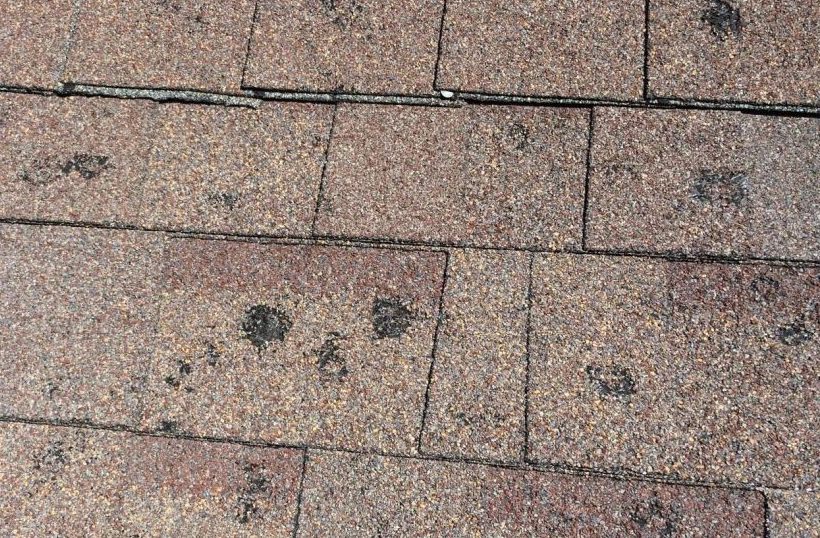
Stand back from a slope and look at how the dark spots are distributed. Hail lands where physics puts it, which is to say nowhere in particular. The marks sit at random spacing, random size, and they ignore the shingle courses completely, running straight across a seam as if the seam were not there. There will be bare patches next to untouched shingles a hand's width away.
Wear does the opposite. It grades. A roof giving up granules from age loses them fastest where the sun sits longest, so the south and west slopes thin out first while the north slope stays dark for years. The loss is even across the field rather than spotted, it follows the exposed lower edge of each course where water runs, and both slopes of a hip will look the same as each other. When a homeowner tells us the roof looks worn on every side equally, that is usually true and usually not hail.
What a bruise feels like under a thumb
Appearance gets you partway. Touch finishes it. A genuine hail impact leaves a spot that gives slightly when pressed, the way a bruised apple does, because the fiberglass mat under the granules has fractured and no longer supports the asphalt above it. The granules at that spot are knocked loose rather than worn away, so the exposed asphalt beneath reads darker and cleaner than the sun-faded asphalt on a worn shingle. Freshly exposed mat sometimes shows the white glass fibers.
A worn shingle is hard everywhere. Press it and it presses back. The exposed asphalt is chalky and oxidized instead of black, and the edges of the bald area fade gradually into granule cover rather than stopping at a rim the way an impact does. That difference in feel is most of why a real inspection has to happen on the roof and not from a driveway. Nobody can palpate a shingle through binoculars.
Four things that look like hail and are not
Blistering
Trapped moisture or excess asphalt in manufacturing makes small raised pockets that eventually pop, leaving round craters with sharp rims. They read as hail at a glance and they fool a lot of people. Blisters cluster in the hottest part of a slope, they are all roughly the same diameter, and the mat underneath is intact. An adjuster who calls your blisters manufacturing defect is very often right.
Foot traffic
Anybody who walked the roof scuffed granules loose along the way. Satellite installers, chimney sweeps, the previous owner hanging Christmas lights. It shows as connected smears in a walking line, heavier at the heel, frequently running the same route from the ladder point to whatever they came up for. Hail does not walk in a line.
Animals and debris
Squirrels chew ridge caps and pipe boots, raccoons pull shingles at the eave, and a falling limb leaves a gouge with directional scraping and often a wood fragment in it. Limb strikes are legitimately claimable as storm damage under most policies, just not as hail, and they get scoped differently. Getting the peril right at the start avoids a fight later.
Nail pops and mechanical damage
A nail backing out of the deck lifts a small dome in the shingle above it and eventually punches through, leaving a round hole that looks like an impact. Look for the pattern: nail pops sit in rows on the fastener line, spaced the way a nailing pattern is spaced. Hail cannot count.
Why an adjuster's age finding is not the end
The most common denial language on a Midwest hail file is some version of wear, tear and deterioration rather than a covered peril. That finding is answerable, and the answer is evidence rather than argument. Mat fracture photographed under a lifted shingle is not something age produces. Bright metal at the bottom of a gutter dent is not something age produces. A test square count on the windward elevation that runs three times the count on the leeward one is a wind-driven pattern and nothing else explains it.
The honest version: sometimes the roof is just old
We say this on inspections every week and it costs us work every week. A twenty-four-year-old three-tab roof with thinning granules on the south face, curled tab corners and no fresh metal dents anywhere on the property is at the end of its service life. There is no hail claim there. Filing one produces a denial that sits on your claim history, and a denied claim does nothing for your file the next time real damage comes through.
That roof still needs replacing, and the useful conversation is about timing and cost rather than about coverage. Sometimes the better call is waiting one more season and putting the money toward a Class 4 impact-resistant shingle so the next storm has a harder target and the carrier gives you a premium credit for it. We would rather give you that answer for free and earn the replacement honestly than talk you into a claim that was never going to hold.
The reverse happens too, and more often than people expect. A roof that looks perfectly sound from the street, four years old and dark on every slope, comes back with forty-one impacts in a ten-by-ten square on the west elevation and a fractured mat under nearly every one of them. That roof is a replacement, and the owner had no idea. Neither finding is visible from the ground, which is the whole reason the inspection exists.
Common questions on wear versus storm damage
Can granules in my gutters mean the roof is only old?
Frequently, yes. Granule shed happens across a roof's whole service life, and a handful in the downspout after a rain is normal on a roof past fifteen years. What points to hail is a sudden volume of granules right after a storm along with fresh dents in the gutter itself.
How old does a roof have to be before hail damage stops being covered?
Age does not remove coverage for a covered peril, though it changes what the settlement pays. An older roof on an actual cash value policy takes heavy depreciation, so the same damage that nets a full replacement on a newer roof can net a fraction of it on a twenty-year-old one.
Will a second opinion contradict my adjuster?
Sometimes, and reinspections do get requested on that basis. What moves a file is not a differing opinion but documentation the first inspection did not capture: mat fracture under lifted shingles, soft metal photographs with the date, and counts recorded per elevation.
Does a roof have to leak before a claim is valid?
No, and waiting for a leak is the most expensive mistake on this list. Hail fractures the mat first and the water follows years later as the fracture opens. By the time a ceiling stains, the storm is often too old to prove and the policy window has closed.
Can you tell the difference from photos I send you?
We can usually tell you whether a roof is worth a trip, which saves everyone time. We cannot settle wear versus impact from a phone photo, because the finding depends on pressing the spot and on lifting a shingle to see whether the mat underneath is fractured.
Related hail damage reading
Free Hail Damage Inspection
No cost, no obligation, and you get the photographs either way.
Free inspection, documented for your claim.
One number reaches dispatch for all forty Midwest metros, answered live 24 hours a day.