
Midwest hail damage · John Beal Roofing since 1947
What Hail Damage Looks Like on a Roof
Most hail damage is invisible from the ground. Here is what it actually looks like up close, and how to tell it apart from ordinary wear.
Short answer
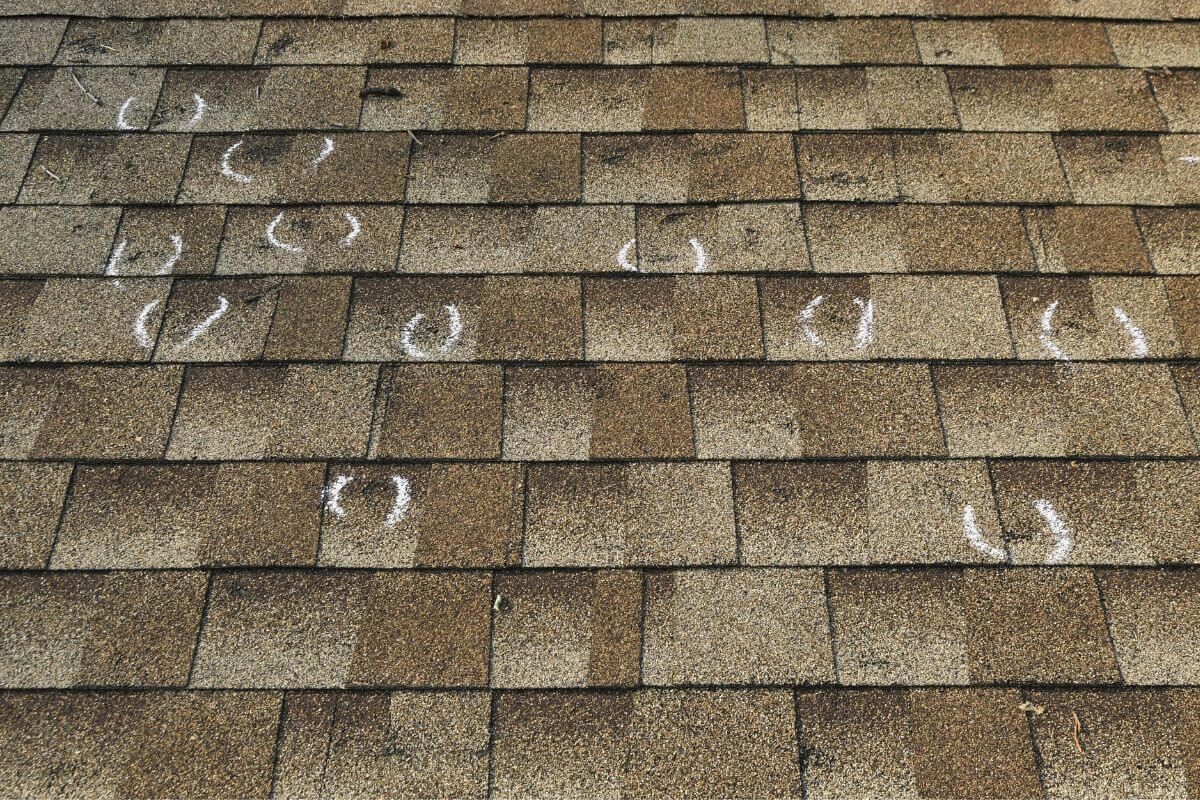
Hail damage on an asphalt shingle roof appears as random, scattered dark spots where granules have been knocked away, with a soft or bruised feel underneath when pressed. Genuine hail impacts have no consistent pattern, expose the black mat beneath, and are accompanied by matching fresh dents on soft metals such as gutters, vents and flashings.
On asphalt shingles
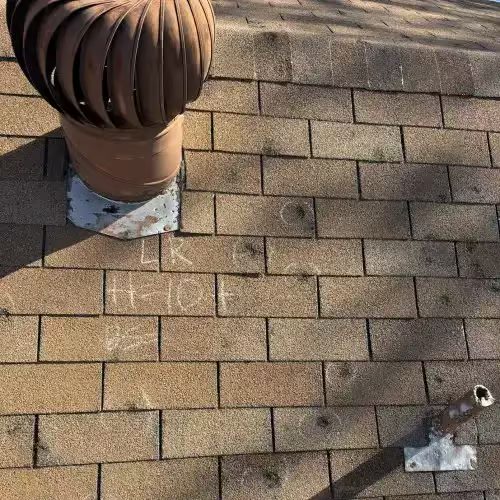
Look for random circular impacts, roughly the size of the hail that fell, where the surface granules have been knocked away and the darker asphalt mat shows through. Press one with a thumb. A cosmetic scuff feels solid. A bruise feels soft, slightly spongy, the way a bruise on an apple does - that softness is the fiberglass mat fractured underneath, and it is the difference between damage that matters and damage that does not. The distribution is the other tell: hail is random, and it does not fall in rows or align with anything.
On metal, vents and soft metals
Aluminum and steel record hail precisely. Look at the gutter faces, the downspout elbows, the furnace flue caps, the turtle vents and the air conditioning condenser fins. Fresh dents expose bright, unweathered metal at the bottom of the impact. Old dents have dulled to match the surrounding surface. This is the most reliable dating evidence a roof carries.
On cedar shake
Cedar splits. A hail split is fresh, sharp-edged, and shows light unweathered wood in the break, often with an impact bruise or indentation at one end. An age split has grayed to match the surface and typically runs with the grain from an existing check. Cedar hail damage documents unusually well once you know the difference.
On tile and slate
These materials crack and spall rather than bruise. Look for fresh chips at the exposed edge of a tile, spalled flakes of slate on the ground or in the gutters, and hairline cracks that run across rather than along the grain. Slate damage is easy to miss and expensive to ignore, because a cracked slate stays in place and leaks quietly.
What is not hail damage
Blistering, which is a manufacturing or ventilation issue and shows as raised bubbles rather than impact craters. Granule loss concentrated in the runoff paths below valleys, which is normal water erosion. Uniform wear across sun-exposed slopes, which is age. Mechanical scuffing in a straight line, which is foot traffic. An honest contractor tells you when what you have is one of these.
Why we would rather you knew this yourself
There is a version of this business that depends on homeowners not knowing what hail damage looks like. We would rather you could recognize it, because an informed homeowner is a homeowner who does not get talked into an unnecessary roof by whoever knocks first. Everything on this page is what we teach our own estimators. John Beal Roofing has been family-run since 1947 and we intend to still be here when you actually need us.
Frequently asked
Can I see hail damage from the ground?
How big does hail need to be to cause damage?
Does hail damage always leak right away?
Will granule loss in my gutters prove hail damage?
Can I inspect it myself?
Related
- Free Hail Damage Roof Inspection
- Hail Damage Roof Replacement
- 24/7 Emergency Roof Tarping After Hail
- Hail Damage Insurance Claim Help
- Storm Damage Roof Repair
- Commercial Hail Damage Roofing
- Siding, Gutter and Window Hail Damage
- The Complete Midwest Hail Damage Guide
- Class 4 Impact-Resistant Shingles for Midwest Hail
- How to Avoid Storm Chasers After a Hail Event
Free Hail Damage Inspection
No cost, no obligation, and you get the photographs either way.
Free inspection, documented for your claim.
One number reaches dispatch for all forty Midwest metros, answered live 24 hours a day.