
Midwest hail damage · John Beal Roofing since 1947
Granules in the Gutter After Hail: What They Mean
A cup of grit at the downspout tells you something happened up top. It doesn't tell you what. Here's how a roofer reads it.
Short answer
Granules in your gutters after a hail storm mean the roof shed some of its surface, and that alone doesn't prove hail damage. A brand-new roof sheds loose granules for its first few months, and an aging roof sheds them steadily with every rain. What points to hail is a sudden heavy deposit right after a storm, paired with dark circular spots on the shingles and fresh dents in the gutters, downspouts or vent caps. Confirming it takes a hands-on roof inspection that checks for a fractured mat under those spots.
Where the grit comes from
Every asphalt shingle is surfaced with ceramic-coated mineral granules pressed into hot asphalt at the plant. They give the shingle its color, but their real job is shading the asphalt from sunlight, which is what breaks asphalt down over the years. A shingle carries more granules than it can hold onto forever, so some come loose under ordinary weather. Rain carries them to the eaves. Your gutter is basically a collection tray for everything the roof gives up, which makes it a decent place to start reading what happened overhead. Just don't read too much into it.
Three reasons you'd see granules, and only one is hail
On a roof less than a year old, loose granules are expected. Shingles ship with surplus that never bonded, and the crew walking the roof during installation knocks more free. That tapers off after a few seasons. On a roof fifteen or twenty years in, shedding is simply age: the asphalt has dried out, the bond has weakened, and the bottom of every downspout shows a gray-black fan after a hard rain whether hail fell or not. The third reason is impact. A hailstone strikes the shingle and blasts the granules off in one shot. That's why a hail deposit tends to land all at once, and heavier than anything you've scooped out before.
Reading the pile under each downspout
Check the splash block or the patch of lawn under every downspout the morning after the storm. Hail on a roof that was shedding very little can leave a visible pile, sometimes with flecks of black asphalt mixed in. Compare one downspout against another. The ones draining the slopes that faced the storm usually carry more, because those slopes took more strikes. If every downspout shows the same light dusting you've always seen, that leans toward age. If the north drains are clean and the west drains are buried, the storm came out of the west and it hit hard enough to matter.
Look up before you decide anything
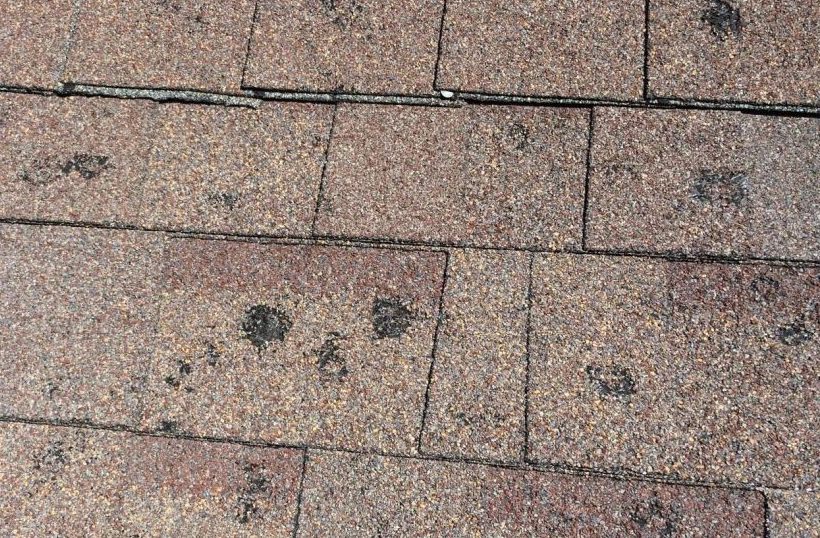
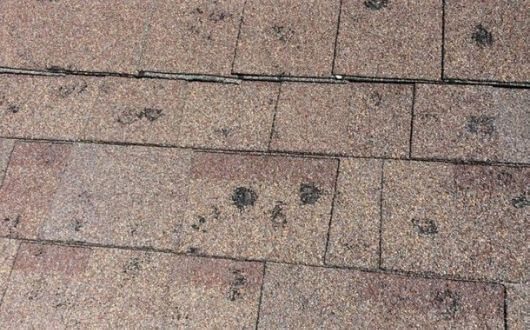
Granules in a gutter are a clue about the shingles, so the next step is the shingles themselves, and a fair amount can be done from the yard. Binoculars on a sunny afternoon will show whether the surface has dark, round spots scattered with no pattern. That's how impact reads. Age wears a slope more evenly and worst along the paths water runs. Then walk the house and look at the metal. A gutter face with small dents, a dinged downspout elbow or a dimpled furnace vent cap tells you hail of some size came through. Our page on what hail damage looks like has more of the visual cues.
Surface loss alone is usually cosmetic
This is the line adjusters draw, and it's a fair one. A shingle that lost granules but kept an intact mat underneath still sheds water. It may age faster in that spot, but most policies treat surface wear as cosmetic and won't pay to replace it. Mat fracture is a different animal. When the stone hits hard enough to crack the fiberglass mat under the granules, the shingle is structurally broken even though it looks close to fine, and that's functional damage. A roofer checks by feeling the impact point. A fractured spot gives under the thumb. A scuff doesn't.
Don't let anyone sell you a roof off a gutter
We've watched it happen. A door-knocker scoops a handful of grit out of a downspout, holds it up to the homeowner and says the roof is finished. Granules alone don't make that case, and an adjuster won't accept them as proof. If your roof is twelve years old and has been shedding for five, the grit in your gutter is the roof getting older, and filing a claim on it invites a denial that stays on your claims history. We'll tell you that straight, even when it means there's no job in it for us. The storm chaser warning page lays out the other tactics worth watching for.
If it is hail, the gutter becomes evidence
Once a roofer has confirmed impacts on the shingles, the granules matter again, this time as part of the record. Photograph the deposit where it landed before you clean anything out, with a coin or a tape in the frame and the date stamp on. Shoot the inside of the gutter runs and the dented faces too. None of that wins a claim by itself. It backs up the test-square counts and soft-metal photos that do, and it helps tie the loss to a specific storm date, which matters when the carrier asks why you're filing when you are. Policies set notice windows, and our page on the hail claim deadline explains how they work.
What the next few winters look like
A roof that took real hail and was never repaired keeps shedding faster than it should. The impact craters have no granule cover left, so sunlight goes straight to work on the exposed asphalt, and each freeze and thaw widens whatever crack the stone started in the mat. Expect heavier grit every spring. A bruised shingle usually keeps water out for two to five years before the fracture opens through. That's why the deposit in your downspout is often the first warning anybody gets, and why the storm behind a ceiling stain may be several seasons gone by the time the stain appears.
When to call us for a look
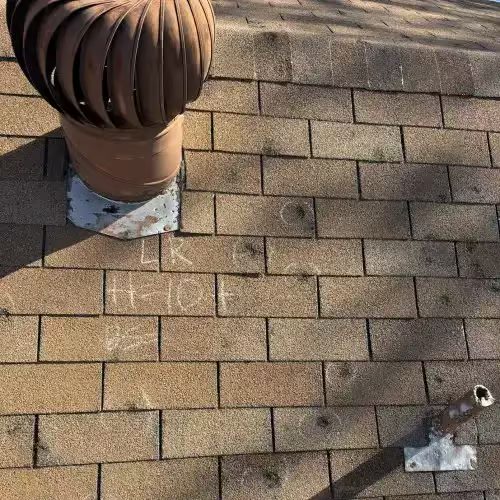
Call after any storm that left hail on the ground, any time the gutters suddenly collect far more than usual, or if you're buying a house and the downspouts are packed with grit. The inspection is free. We get on the roof, chalk a test square on each slope, count the strikes, press each one to check the mat and photograph the soft metals. Then you get the pictures whether you hire us or not. John Beal Roofing is a family company, third generation, and the storm line at 1-800-564-6232 is answered by a live person at any hour.
Frequently asked
Is it normal to find granules in the gutters of a brand-new roof?
Yes, for the first several months. Shingles carry surplus granules that never fully bonded, and installation foot traffic loosens more. The shedding should taper off noticeably within the first year or so.
How many granules in the gutter is too many?
There's no fixed amount a roofer can point to. The useful comparison is against your own roof's history: a sudden heavy deposit right after a storm means more than a steady layer you've been cleaning out for years.
Will insurance pay for granule loss?
Usually not on its own, because most carriers treat surface granule loss as cosmetic. They pay when the impacts fractured the shingle mat, which is functional damage, and establishing that is the inspection's job.
Should I clean out the gutters before the inspection?
Wait a few days if you can, and photograph the deposit first, inside the runs and under each downspout, with the date visible. If the gutters are overflowing toward the foundation, take the pictures and then clean them.
Can pressure washing a roof cause granule loss?
It can strip granules fast, and the pattern follows the spray rather than scattering at random the way hail does. It isn't storm damage and isn't covered. We don't recommend pressure washing asphalt shingles at all.
Related reading
Free Hail Damage Inspection
No cost, no obligation, and you get the photographs either way.
Free inspection, documented for your claim.
Call one number from any of our forty Midwest metros and a live dispatcher answers, day or night.