
Midwest hail damage · John Beal Roofing since 1947
Wind Damage vs. Hail Damage: Reading a Midwest Roof
Most Midwest storms bring wind and hail together. They break a roof in different ways and get documented differently, and mixing them up is one of the easiest ways to end up with a short scope.
Short answer
Hail damage shows up as random, roughly round impacts spread across every slope that faced the storm, with bruised or fractured mat under the displaced granules and dents in soft metals. Wind damage is directional: creased, lifted or missing shingles concentrated at edges, corners, ridges and the windward side, with broken seal strips and nothing dented. A single Midwest storm often causes both, and each one is documented and scoped on its own terms.
Read the pattern first
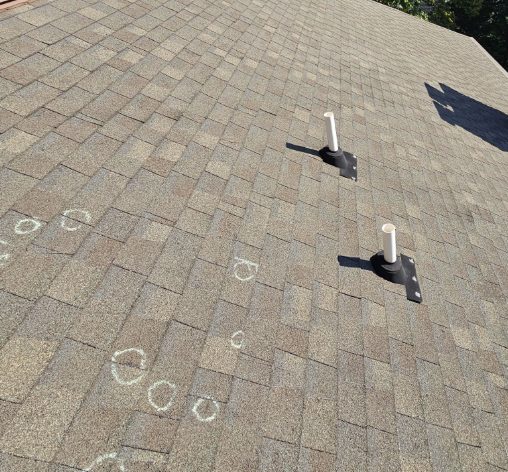
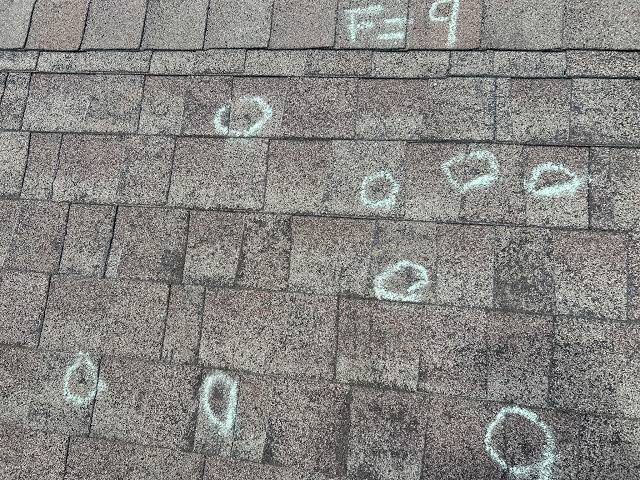
Before we look at any single shingle, we look at where the damage sits. Hail is random. Stones land wherever they fall, so impacts scatter across a slope with no regard for edges, seams or ridgelines, and they're heaviest on the elevations that faced the storm. Wind is organized. It goes after the parts of the roof where airflow pulls hardest: eaves, rakes, corners, the ridge. A slope with damage clustered along one edge and nothing in the field is almost always a wind story.
Up close on a hail strike
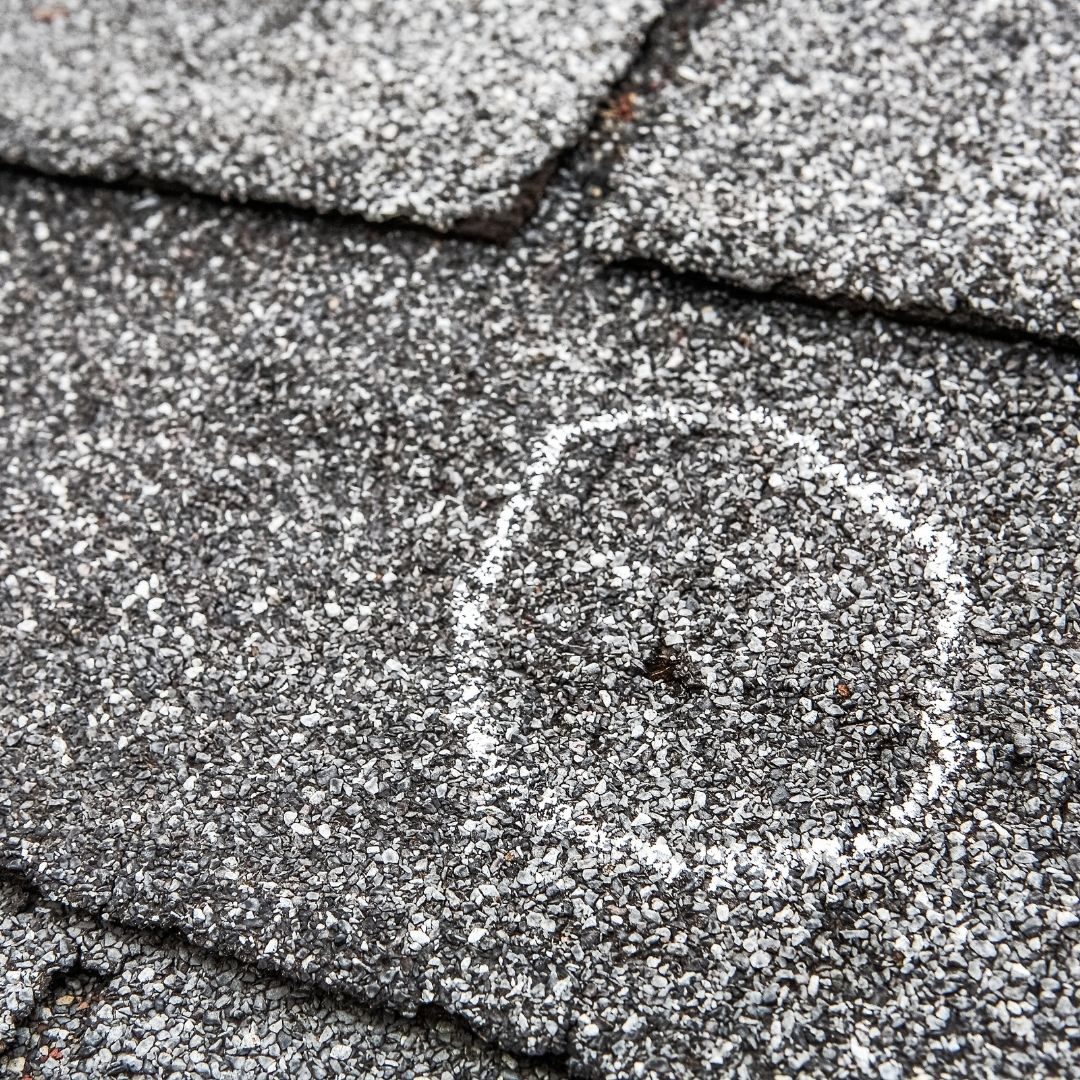
A fresh impact on asphalt leaves a dark spot where granules got knocked loose, usually round or slightly oval. Press the center and a bruised shingle gives under your thumb, because the fiberglass mat beneath it cracked. That fracture is the damage that counts; missing granules on their own are cosmetic. An adjuster will mark a ten-foot test square on each elevation and tally the hits inside it. Hail also writes its signature on soft metal, and that's often what settles the question.
What wind leaves behind
Wind damage involves no impact at all. It's the shingle being pried up. You'll find tabs folded back with a straight crease near the nail line, seal strips torn loose, pieces snapped off and gone, ridge caps peeled away and nail heads exposed where a shingle used to cover them. Nothing on the metal will be dented, though you may see a gutter pulled away from the fascia or a drip edge bent upward. The tell is direction. The damage lines up with where the wind came from.
Soft metal settles most arguments
When a carrier pushes back on shingle damage, the metal usually decides it. Hail leaves round dents with bright, unoxidized bottoms in aluminum and thin steel, and those dents line up with the side of the house the storm hit. Wind on its own doesn't dent metal. So a roof with crisp dents in every vent cap and a row of creased tabs along the west rake has both perils in play, and the photos should show each one. A roof with creased tabs and perfectly smooth metal had a wind event, and claiming hail on it will go nowhere.
Why adjusters treat them differently
Hail is usually scoped by count. If the test square on a slope crosses the carrier's threshold, that slope tends to move toward replacement. Wind is usually scoped shingle by shingle: the adjuster counts what's missing or creased, and if the damage is limited the scope may be a repair. Two perils on one roof can mean one slope replaced for hail and another repaired for wind. Matching repaired shingles to the rest of the roof is governed by your policy and state rules, which we cover on our matching law page.
One storm, one date, two lines on the scope
When a storm brings both, it's still one loss with one date. The scope should list hail damage and wind damage separately, with photographs for each, so nothing gets folded into the wrong category and dropped. We meet the adjuster on the roof for exactly this reason, and our notes on the adjuster's roof inspection explain how that visit goes. Carriers generally group wind and hail under one coverage, so you're usually paying one deductible for the event, not two.
The look-alikes
Not every mark on a roof came out of the sky. Blistering on an older shingle pops small craters that can pass for hail until you notice none of the metal is dented. Foot traffic scuffs granules in a line along wherever somebody walked. Thermal cracking and plain wear show up evenly across the whole roof. Our guide to hail damage versus normal wear has the side-by-side. On the wind side, shingles nailed above the manufacturer's nailing zone blow off in storms a properly installed roof would ride out, and that's an installation problem, not storm damage.
When we tell you it's neither
Sometimes we walk a roof after a storm and find an old roof with ordinary wear and no fresh damage at all. When that happens we say so, and we put it in writing. Filing on wear gets a denial and a claim on your record. Filing on real damage, with the right peril named and photographs to back it, is how these claims get paid. You'll get our honest read either way, along with the dated photo file.
Frequently asked
Can wind alone total a roof?
It can, when enough shingles are creased, unsealed or missing across enough slopes that a repair stops making sense. It's less common than with hail, because wind damage usually concentrates on the edges and one side of the house.
I'm missing a few shingles after a storm. Is that a hail claim?
Missing shingles are wind damage. You may have hail damage as well, but it shows up as impacts, not missing pieces. Get the whole roof inspected so both are documented before you file.
Why does the adjuster count hail in a square but wind by the shingle?
Hail lands randomly across a slope, so a sample square tells you the density. Wind damage isn't random, and sampling a square would miss most of it. Each damaged shingle gets counted individually instead.
Can a creased shingle just be resealed?
No. The crease is a fracture in the mat, and hand-sealing the tab doesn't fix it. The shingle has to be replaced, and on an older roof that's harder than it sounds, because brittle neighboring shingles crack when you lift them.
Does it matter which peril I put on the claim form?
Describe what happened: the date, that the storm had wind and hail, and what you've noticed. You don't have to diagnose it yourself. The inspection and the adjuster's visit sort out which damage belongs to which peril.
Related reading
Free Hail Damage Inspection
No cost, no obligation, and you get the photographs either way.
Free inspection, documented for your claim.
Call one number from any of our forty Midwest metros and a live dispatcher answers, day or night.