
Midwest hail damage · John Beal Roofing since 1947
Architectural vs. 3-Tab Shingles: How Your Shingle Type Shapes a Hail Claim
Two houses on one street can take the same storm and come out with very different estimates. A lot of the time, the gap starts with the kind of shingle somebody nailed down twenty years ago.
Short answer
Shingle type changes a hail claim in three places: how much damage the storm actually does, how the adjuster prices the loss, and whether a repair is even possible. A 3-tab shingle is a single thin layer, so hail fractures its mat at smaller stone sizes. An architectural (laminated) shingle is two bonded layers, takes a harder hit and carries a higher price per square on the estimate. Many older 3-tab colors are no longer made, so a damaged 3-tab roof often can't be patched to match, which pushes the claim toward replacement.
Two shingles that only look like cousins
Pull a 3-tab out of a bundle and hold it up. It's one flat sheet of fiberglass mat soaked in asphalt, granules pressed into the top, and two slots cut into the bottom edge so it reads as three separate pieces once it's on the roof. That's the entire shingle.
An architectural shingle, which you'll also hear called laminated or dimensional, is two of those sheets glued together. The bottom layer is cut into uneven tabs that throw a shadow line. You get more asphalt and more mat, so more weight per square. It's what most Midwest houses have gotten for the last couple of decades, and it's what we put on nearly every residential job.
For hail, the extra layer matters in a simple way. A stone that would crack one mat has to get through two wherever the layers overlap. That doesn't make the shingle hail-proof. It moves the line.
Where the damage line falls on each type
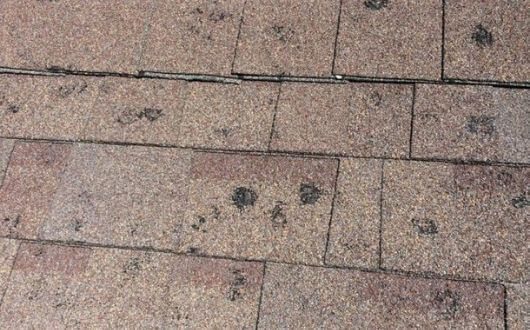
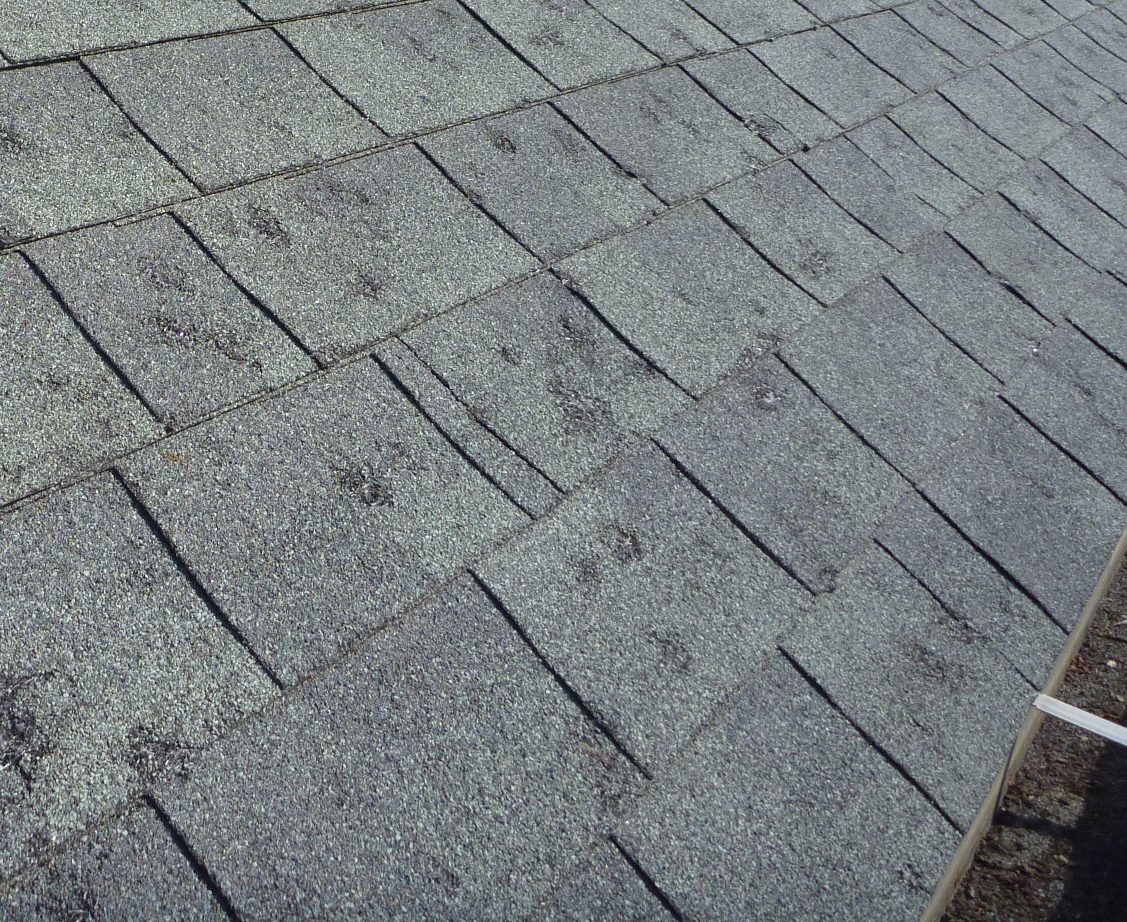
On 3-tab, we start finding broken mats with stones a little under an inch, especially on an older roof whose asphalt has dried out. The bruise usually shows as a dark spot where granules got knocked loose, and pressing it with a thumb feels like the soft spot on an apple. On a thin shingle the crack sometimes runs all the way through.
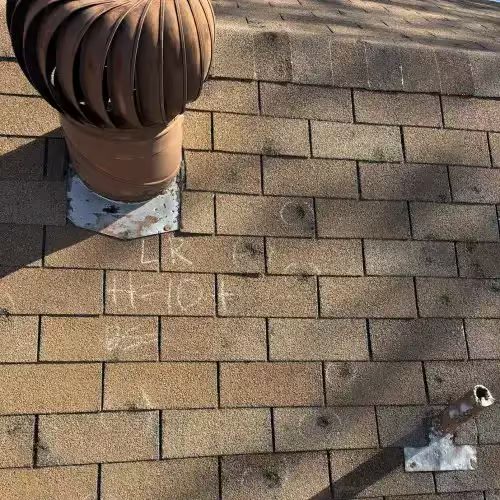
Laminated shingles usually hold until the stones get bigger, and the damage sorts itself differently. Hits on the double-thick portion often bruise without breaking through. Hits on the single-layer strip above the tab cutouts, or right on the exposed edge, are where the mat gives out first. When we chalk a test square on a laminated roof, we pay attention to where each mark lands, not just how many there are.
On either shingle, the granule loss you can see is the cosmetic part. The fracture underneath is what becomes a leak, usually a few winters later, once sun and freeze-thaw cycles have pried it open. Our hail size chart lays out what different stone sizes tend to do.
How an adjuster prices each one
Insurance estimates get built line by line, and the shingle line is priced by type. A laminated shingle carries a bigger material and labor number per square than 3-tab, so the same size roof produces a larger replacement figure. That's no trick. It's what the materials cost.
Type also drives the depreciation math on an actual cash value policy. Carriers assign expected lifespans by product, and an older 3-tab roof may already be written down heavily by the time hail shows up. If your policy pays ACV, the first check on a 3-tab roof in its late teens can be thin. Our page on ACV versus RCV roof claims walks through how that holdback works.
Watch for one specific mistake: an estimate that lists 3-tab when your roof is laminated, or the other way around. It happens more than people expect, usually because a default line got pulled during a busy week. It's the first line we check on any estimate a homeowner hands us. When it's wrong, it goes into a claim supplement with photos of the shingle that's actually up there.
The matching problem on older 3-tab roofs
Here's where 3-tab gets complicated. Manufacturers have trimmed their 3-tab lines over the years, and plenty of the colors that went onto Midwest houses in the 1990s and early 2000s simply aren't produced anymore. When a hail-damaged 3-tab slope needs a repair, there may be nothing on any supply yard shelf that looks like what's up there.
That matters because many policies, and some state rules, expect a repair to leave a reasonably uniform roof. If no matching shingle exists, the case for replacing the full slope or the whole roof gets a lot stronger. Each state handles this its own way, so read our breakdown of matching laws for roofs and siding before you agree to a patch.
Laminated shingles aren't immune. Color blends change, and a new shingle never looks quite like one that's baked through fifteen summers. Still, the odds of finding a close relative are better.
Going back with 3-tab after the claim
Usually we'd advise against it, even when the claim would cover it. Insurance pays to put back what you had, so a 3-tab roof is normally replaced with 3-tab on the estimate. Moving up to laminated shingles typically costs the homeowner the difference. On most homes that difference is modest next to the full job, because tear-off, underlayment, flashing and labor barely change.
What the money buys: a heavier shingle that takes hail better and stands up to wind better, and one that's far easier to match the next time something happens. In a high-hail market, look at going one step further to a Class 4 impact-rated laminate. Those carry a UL 2218 rating, and many carriers give a premium credit for them. We cover that call on our page about whether Class 4 shingles are worth it, and compare product lines in the best shingles for hail.
There's one case where we won't push the upgrade. If you're selling the house in a few months and the buyer only needs a sound, new roof, a like-for-like replacement may be the honest recommendation.
Telling them apart from the driveway
You don't need a ladder for this. Look along the bottom edge of any slope. Straight, evenly spaced slots and a flat, uniform face mean 3-tab. Staggered tabs of different widths with a dark shadow band mean laminated. A leftover bundle in the garage or the original contract settles it for sure. Then call 1-800-564-6232 for a free inspection, and we'll photograph the test squares and note the shingle type on every slope.
Shingle-type questions we hear on hail claims
Does 3-tab get damaged by smaller hail than architectural shingles?
Generally yes. A single layer leaves less material between the stone and the mat, so fractures appear at smaller sizes, especially on an older, brittle roof. Age, slope direction and the angle the storm came in on all shift that line.
Will insurance pay for laminated shingles if my old roof was 3-tab?
The estimate usually restores what you had, which means 3-tab, and you can pay the difference to upgrade. Some situations, such as no matching 3-tab being available for a repair, can change what the carrier owes, so ask before you sign off on the scope.
Can a few laminated shingles be patched into a 3-tab roof?
Physically, yes. But the two look nothing alike, and the profiles don't lie flat together at the transition. Most owners who try it regret it. If a matching 3-tab can't be found, that's a reason to ask for a larger replacement instead.
My estimate lists the wrong shingle type. What now?
Photograph the tab pattern and a lifted shingle edge on each slope, then send it to your adjuster asking for the line item to be corrected. A contractor can submit it as part of a supplement. Don't let it slide, because it changes the dollar figure.
Is an architectural shingle the same thing as an impact-resistant one?
No. Architectural describes the two-layer build. Impact-resistant means the product passed UL 2218 testing at Class 4. Some laminated shingles are Class 4 and plenty aren't, so check the data sheet or the bundle wrapper.
Related reading on shingles and claims
Free Hail Damage Inspection
No cost, no obligation, and you get the photographs either way.
Free inspection, documented for your claim.
Call one number from any of our forty Midwest metros and a live dispatcher answers, day or night.