
Midwest hail damage scope disputes · John Beal Roofing
Partial Roof Replacement On A Hail Claim
Some partials are honest settlements. Some leave you with two roofs of different ages and a color band across the front of the house. Telling them apart takes about ten minutes on the roof.
Short answer
Carriers approve a partial roof replacement when hail totaled some elevations and the remaining slopes test clean. That is a legitimate settlement on a roof with genuinely separate planes, like a detached garage or a rear elevation the storm never reached. It turns into a problem when the split runs through a shared ridge, when the shingle color has been discontinued, or when your state's matching rules or your policy's own language call for a uniform appearance across a continuous surface. The way to move a partial is rarely arguing harder. It is showing the carrier why two slopes cannot physically be separated.
Why hail takes one slope and leaves another
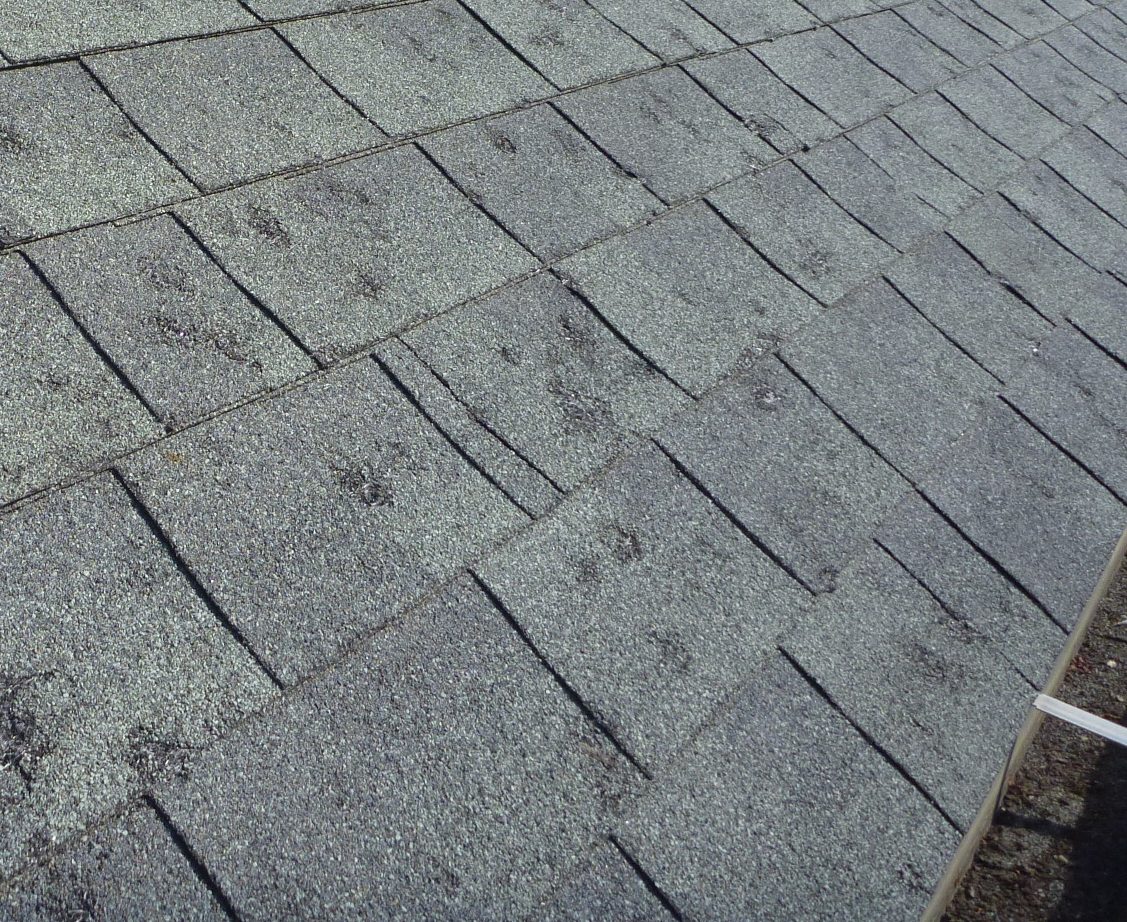
Hail almost never falls straight down. It arrives on a wind vector, so the elevations facing into the storm collect the strikes and the elevations facing away can come through nearly untouched. In most Midwest events that means the south and west slopes carry the damage. Pitch changes the arithmetic too, because a low slope presents more surface to a stone coming in at an angle than a steep one does. A neighbor's two-story or a mature oak on one side of the house will shield a slope well enough to keep it off the claim. A one-sided roof is common and it is usually not the adjuster being cheap.
Where a partial genuinely works
A detached garage or outbuilding
Its own structure, its own roof planes, no shared ridge with the house. Replacing one and not the other bothers nobody in five years.
An addition on its own plane
If the addition already carries a different shingle or a different pitch and terminates at a wall rather than a shared ridge, it stands alone.
A low-slope porch or bay
Rolled goods, modified bitumen or standing seam over a porch is a separate system. It gets scoped and priced separately, as it should be.
A house already roofed in sections
Some homes were re-roofed piecemeal by previous owners. When the field is already mismatched, a partial does not introduce a problem that was not there.
A slope that is honestly undamaged
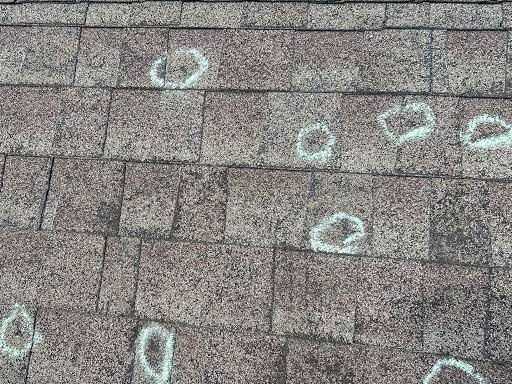
If we chalk a test square on your north elevation and find four strikes in a hundred square feet with no mat fracture, that slope has years left. We will say so.
Where the split creates a roof you fight later
The ridge is where most partials fall apart. Cap shingles are nailed through both sides of a gable, so there is no way to tear off one slope without pulling the cap that also seals the other one. Set the old caps back down and you are re-bedding shingles that hail already bruised, in the same course you just told the carrier is fine. Then there is the seal strip. New shingles have to tuck under the top course of the old field, and a shingle five or six years into its life will crack when you break that seal in cool weather. Manufacturer coverage narrows too, because a system warranty applies to the system that was actually installed.
The color band problem is real and it is permanent
Asphalt weathers. A five-year-old roof in the same product and the same color number is a visibly different shade than a bundle off the truck this week, and the difference is most obvious on the elevation the street sees. It fades toward each other over years, never completely. If the color has been discontinued, and shingle lines get retired constantly, there is no version of a partial that blends. That is where your state's matching statute or the continuous-surface language in your policy becomes the argument, not the shingle.
What to ask for instead of arguing
Ask for three specific things in writing. First, the full slope rather than a repair area, since a bruised field cannot be patched with any honesty. Second, the ridge line included, with the physical reason attached. Third, the code items the tear-off triggers, meaning starter, drip edge, ice and water shield where the municipality requires it, and ventilation. Raise the matching question separately and afterward. Mixing a construction argument with a coverage argument lets a carrier answer the easy one and skip the hard one.

The partials we agree with
We write two-slope scopes and we stand behind them. If the back of your house tests clean, telling you it needs to come off would be selling you something you do not need, and we have been in St. Louis too long to build a business on that. What we will not do is take on a partial we think fails. When we believe a slope is totaled or a ridge cannot be split, we put the reason in writing with photographs, send it to the carrier, and ask for a reinspection with our estimator on the roof at the same time.
Questions we get on this one
Will a partial replacement void my shingle warranty?
It does not void anything retroactively, but it limits what is covered. Manufacturer coverage follows the material and the installation, so the new slopes carry the new warranty and the old slopes keep whatever remains of the original. A full system warranty from a manufacturer generally requires the full system, which is one reason partials are worth pushing back on when the roof is close.
Can new shingles be woven into old ones on the same slope?
Physically yes, and we avoid it. Breaking the seal on a weathered course to slide new material underneath cracks shingles more often than not, especially below sixty degrees. Where a tie-in is unavoidable we do it at a natural break like a valley or a wall line, never in the middle of an open field.
My neighbor across the street got a whole roof and I got two slopes. How?
Different roof geometry, different shingle age, different adjusters, and sometimes a different carrier reading the same storm. Orientation matters most. Their gable may face the storm track squarely while your hip sheds the same stones at an angle. Ask us to compare test square counts, since that is the number the decision was built on.
Does a partial replacement have to be disclosed when I sell the house?
Disclosure rules vary by state, but a roof with two install dates comes up in every inspection regardless. Keep the scope, the invoice and the photos. Buyers accept a documented partial far more easily than they accept an inspector telling them the roof looks mismatched and nobody can explain why.
How long does the color difference stay obvious?
Expect it to be noticeable for the life of the roof, most sharply in the first two or three years. Granule color shifts as the surface weathers, so the two areas move toward each other and then stop. On a street-facing elevation that is a real consideration, and it belongs in the matching conversation with your carrier.
Keep reading
Get A Second Set Of Counts
Send us the slopes in question and we will chalk squares on every elevation, free.
A partial should be a decision, not a default.
Call storm dispatch and we will get an estimator on the roof before you sign anything.