
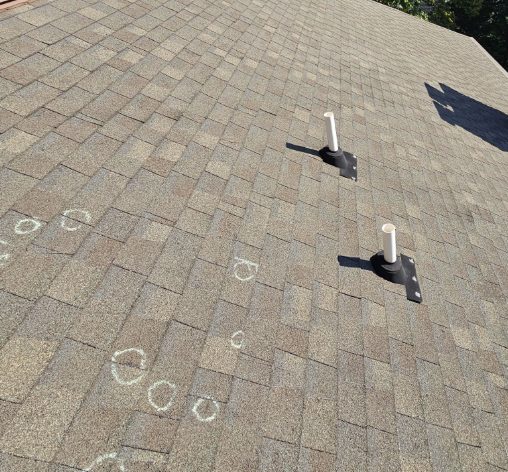
Midwest hail damage · Residential and commercial metal
Hail Damage on a Metal Roof: Dents, Coatings and Claims
Hail rarely breaks a metal roof. It dents it. Whether that dent is a claim depends on the coating, the seam, the gauge, and one endorsement buried in your policy.
Short answer
Hail rarely breaks a metal roof, it dents it. Standing seam panels and metal shingles usually keep shedding water after a hailstorm, so a metal claim turns on whether the impact fractured the paint and coating system, cracked a sealant joint, or deformed a seam or clip. Many Midwest policies now carry a cosmetic damage exclusion on metal roofing, and that endorsement decides more metal roof claims than the dents themselves do.
What actually fails on a metal roof after hail
Asphalt fails by fracturing a mat you cannot see. Metal fails in five separate places, and a dent in the flat of a panel is only the first and usually the least consequential of them. An inspection that stops at counting dents in the field misses the parts that will cost you a roof in eight years.
Panel deformation and oil canning
The dish a stone leaves in the flat of a panel is a dent in sheet steel or aluminum, and by itself it does not let water in. What it does is stretch the metal, and stretched metal reads as waviness between the ribs that gets worse in direct sun. On a low-slope panel a deep enough dish will pond water, and standing water on a coated panel is how corrosion starts.
Coating and paint fracture
This is the finding that matters most and gets looked for least. A metal panel survives outdoors because of its coating stack: the metallic coating on the steel, then a primer, then the finish. A hard enough impact can craze or fracture that finish at the strike point even when the dent looks cosmetic, and once the coating is broken the bare substrate is exposed. Rust starts in the bottom of the dish and works out. On a twenty-six gauge painted panel we look for crazing, chalking at the impact, and any point where the finish has flaked to bright metal.
Seams and clips
A standing seam roof keeps water out at the vertical seam, and the seam is the part hail can genuinely compromise. A strike directly on the rib can open a mechanically seamed joint slightly or unseat a snap-lock, and an impact hard enough to move the panel can deform the concealed clip holding it to the deck. A deformed clip does not leak today. It fails the panel's ability to move with temperature, and thermal cycling finishes the job.
Fasteners and gaskets on exposed-fastener panels
Corrugated and R-panel roofs, common on Midwest outbuildings and light commercial, are held by thousands of screws with neoprene washers. Hail hits the screw heads, splits washers, and backs fasteners out of the purlin. Every one of those is a future leak path, and a hailstorm can compromise a substantial fraction of them at once.
Trim, flashings and the gutter run
Ridge caps, hip covers, rake and drip trim, valley metal, pipe flashings and the gutters are all lighter gauge than the panels. They dent at sizes that leave the field untouched, and because they are formed rather than flat, a dent in a folded edge distorts the geometry the water relies on. Damaged trim is the most frequently omitted line on a first metal roof scope.
The cosmetic damage exclusion
Over the last decade, carriers writing in high-hail Midwest states added an endorsement that excludes cosmetic damage to metal roofing, siding and trim. The wording varies by carrier and it generally says the policy covers damage that affects the roof's ability to keep water out, and does not cover marring, denting or a change in appearance. Some versions exclude the cosmetic component while paying for function. Some require a separate cosmetic-damage deductible. A few exclude metal roof surfaces from hail coverage entirely.
Read your declarations page and look for an endorsement number with cosmetic in the title. If one is on your policy, the inspection strategy changes completely: dent counts in the field are close to irrelevant, and the whole file rests on coating fracture, seam and clip deformation, fastener and washer failure, and damaged trim. Those are functional findings, they are documentable, and they are not cosmetic by any definition the endorsement uses. Plenty of metal claims get paid on policies with the exclusion, because the damage that was documented was not the kind the exclusion names.
Also check the deductible structure while you have the page out. A large share of Plains-state policies carry a percentage wind and hail deductible rather than a flat dollar one, which on a metal roof claim can mean a deductible several times what the homeowner assumed. We walk through how that plays out on our page on premiums and percentage deductibles.
Gauge and substrate change the outcome
Not all metal takes hail the same way and the differences are large. Twenty-four gauge steel is meaningfully stiffer than twenty-six, and twenty-nine gauge agricultural panel dents at sizes the heavier stock shrugs off. Aluminum is softer than steel at equal thickness, which is why aluminum shingles and aluminum gutters dent readily, though aluminum will not rust when the coating breaks. Copper and zinc dent easily and patina over the strike. Stone-coated steel shingles behave like a third thing entirely, shedding their stone coating at the impact the way an asphalt shingle sheds granules.
Substrate underneath matters as much as the metal on top. A panel screwed down over solid decking with an underlayment has something behind it to resist a strike, and it dents shallowly. The same panel spanning open purlins on a pole barn has nothing behind it, so the stone deflects the panel between supports and you get deep dishing and sprung fasteners. That is why the shop on the back of a property is often hit harder than the house.
How we inspect a metal roof after a storm
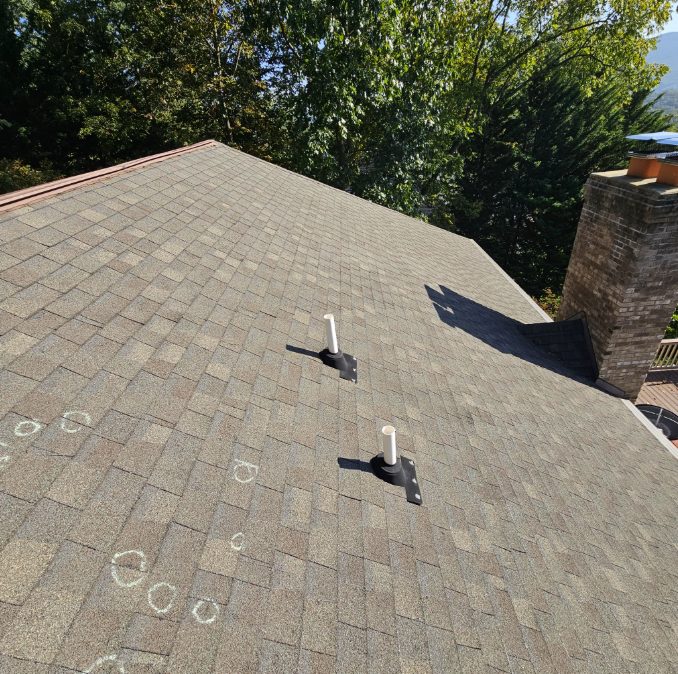
Metal takes a different method than asphalt. We still chalk a ten-by-ten square per elevation, because carriers expect a count in a defined area, but the photographs we take inside it are close and raking rather than straight down. Low-angle light across a panel reveals dishing that a perpendicular shot flattens out. Then we work the seams by hand along their length, check clips where a panel can be lifted at a rake, pull a sample of fasteners on exposed-fastener sections to see washer condition, and photograph every trim run separately.
What we will not sell you
We will not tell you a metal roof with shallow field dents and an intact coating needs replacing. It does not. A dented panel with a sound finish will outlast the asphalt roof next door by decades, and swapping it because it stopped looking new is an expensive decision that no adjuster is going to fund and that we are not going to recommend. If the finding is cosmetic, that is what goes in the report.
We also will not spot-replace panels in the middle of a run and tell you it will match. Metal finishes fade, production runs differ, and a new panel set beside a fifteen-year-old one reads as a repair from the street permanently. Sometimes that is the right trade for a functional fix and we will say so. What we will not do is pretend the color will blend, which is the same problem matching statutes exist to address on shingle and siding claims.
Metal roof hail questions
Do dents in a metal roof actually need to be repaired?
Only when they affect function. A shallow dish in a panel with an intact coating keeps shedding water and can be left alone. A dent that fractured the finish, ponds water on a low slope, or came with a sprung seam or fastener is a different matter and does need addressing.
Will my insurance pay for a dented metal roof?
It depends on whether your policy carries a cosmetic damage endorsement for metal, and on what the inspection documents. Coating fracture, seam and clip deformation, split fastener washers and damaged trim are functional findings that get paid on many policies that exclude appearance alone.
Is a metal roof still worth it in a hail-prone part of the Midwest?
For most properties, yes, provided you buy enough gauge and install over solid decking. Heavier steel over a deck resists impact well and lasts decades. Thin agricultural panel over open purlins is the version that disappoints people after their first large storm.
Can a dented metal panel be repaired instead of replaced?
Field dents cannot be pulled out of a formed panel in any way that lasts, so repair on metal means replacing affected panels, trim or fasteners rather than reworking them. Touching up broken coating is a stopgap that buys time on an isolated strike, not a fix for a whole elevation.
Does hail damage to a metal roof void the manufacturer warranty?
A finish warranty generally covers fading and chalking under normal weathering and excludes impact, so hail damage is a claim against your insurance rather than the manufacturer. Our workmanship warranty covers what we install, and an impact event is separate from both.
Related storm damage pages
Free Hail Damage Inspection
No cost, no obligation, and you get the photographs either way.
Free inspection, documented for your claim.
One number reaches dispatch for all forty Midwest metros, answered live 24 hours a day.